
Protein Calculator
Estimate how much protein to eat per day, as a range in grams, from your weight, exercise and goal. For healthy adults.
Before you use the result
- If you have kidney disease or your doctor has told you to limit protein, don't use this number; follow your doctor's advice.
- Pregnancy, breastfeeding, children and teenagers have different needs. Please talk to a doctor or dietitian.
- Adults aged 65 and over may need more protein than the general adult range.
About you
For healthy adults
Your result will appear here
Enter your weight, then choose your exercise level and goal
Results are estimates to help you look after your health, not a medical diagnosis. If you are pregnant, have a health condition or are worried about your weight, talk to a doctor or dietitian.
What you enter is used only for the calculation in this browser. Nothing is saved or sent anywhere.
How to read the result
Why the result is a range
Protein needs vary with health, age, activity and personal circumstances, so no single number suits everyone. The ranges come from published recommendations; any amount in the range is a reasonable starting target.
The range used in each case
The calculator takes one range for your exercise level and one for your goal, and uses the higher one. This table shows grams per kilogram of body weight per day for every case.
| Exercise | Stay healthy, keep my weight | Lose weight | Build muscle |
|---|---|---|---|
| Little or no exercise | 0.8–1.0 | 1.2–1.6 | 1.6–2.2 |
| Regular exercise | 1.2–1.6 | 1.2–1.6 | 1.6–2.2 |
| Hard training or athlete | 1.6–2.0 | 1.6–2.0 | 1.6–2.2 |
Spread it across meals
Splitting protein over several meals, for example about 25–30 g per meal, helps with fullness more than eating it all at once. Everyday foods such as eggs, fish, meat, tofu, beans and milk can cover this range.
If you are well above a healthy weight
Calculating from your total body weight can give more than your body needs. If you are well above a healthy weight, talk to a dietitian, who may use an adjusted body weight instead.
How it's calculated and where the numbers come from
Formula
- Protein per day (g) = body weight (kg) × grams-per-kilogram range
- Grams-per-kilogram range = the higher of the range for your exercise level and the range for your goal
Example: 55 kg, regular exercise, goal to build muscle → range 1.6–2.2 g/kg → 55 × 1.6 = 88 to 55 × 2.2 = 121 grams per day.
- 0.8–1.0 g/kg (little exercise): the Recommended Dietary Allowance for adults is 0.8 g/kg, which meets the needs of nearly all healthy adults; WHO gives 0.83 g/kg. The upper end, 1.0, is a small margin chosen by Fatnever.
- 1.2–1.6 and 1.6–2.0 g/kg (regular exercise, hard training): the two halves of the 1.2–2.0 g/kg recommended for active people.
- 1.2–1.6 g/kg (losing weight): the range a review found helps with fullness and keeping muscle while losing weight.
- 1.6–2.2 g/kg (building muscle): a meta-analysis found that muscle gained with resistance training barely increases above about 1.6 g/kg per day, with the upper confidence limit near 2.2.
- Pounds are converted to kilograms first (1 lb = 0.45359237 kg). Results are rounded to whole grams.
Limitations
- For healthy adults only. It doesn't take age, sex or medical conditions into account.
- Eating more than this range gives most people no extra benefit and may not suit some conditions.
- The number is protein from all food in a day, not an amount you need from supplements.
Sources
Institute of Medicine (2005). Dietary Reference Intakes for Energy, Carbohydrate, Fiber, Fat, Fatty Acids, Cholesterol, Protein, and Amino Acids. Washington, DC: The National Academies Press.
WHO/FAO/UNU Expert Consultation (2007). Protein and amino acid requirements in human nutrition. WHO Technical Report Series 935.
Thomas DT, Erdman KA, Burke LM (2016). Position of the Academy of Nutrition and Dietetics, Dietitians of Canada, and the American College of Sports Medicine: Nutrition and Athletic Performance. J Acad Nutr Diet, 116(3), 501–528.
Jäger R, et al. (2017). International Society of Sports Nutrition Position Stand: protein and exercise. J Int Soc Sports Nutr, 14, 20.
Leidy HJ, et al. (2015). The role of protein in weight loss and maintenance. Am J Clin Nutr, 101(6), 1320S–1329S.
Morton RW, et al. (2018). A systematic review, meta-analysis and meta-regression of the effect of protein supplementation on resistance training-induced gains in muscle mass and strength in healthy adults. Br J Sports Med, 52(6), 376–384.
Bauer J, et al. (2013). Evidence-based recommendations for optimal dietary protein intake in older people: a position paper from the PROT-AGE Study Group. J Am Med Dir Assoc, 14(8), 542–559.
Related tools
Macro Calculator
Split your daily calories into grams of protein, carbohydrate and fat
Calorie Deficit Calculator
Estimate your BMR, TDEE and a safe daily calorie target for weight loss
BMI calculator
Check whether your weight suits your height, and see the healthy weight range for your height.
Related products
Affiliate link: Product links are Shopee affiliate links. If you buy through them, Fatnever earns a small commission at no extra cost to you. Read our disclosure
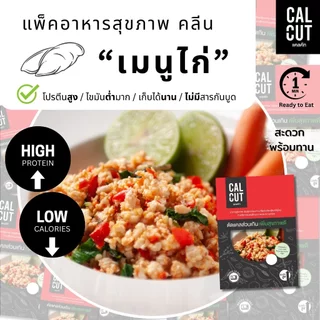
Calcut อกไก่ผัดไม่น้ำมัน อาหารคลีน อร่อย พร้อมทาน สุขภาพ เปลี่ยน นน. โปรตีนสูง อกไก่ เชฟเต้ย โปรตีน ลีน เฮลตี้ cleanfood (opens in a new tab)
See the current price and offers on Shopee
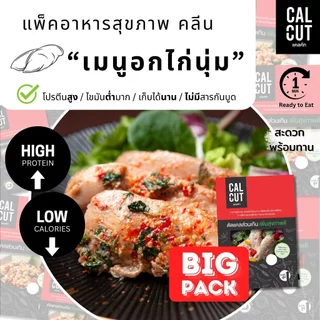
Calcut อกไก่นุ่ม อร่อย พรีเมี่ยม อาหารสุขภาพ คลีน อาหารคลีน เปลี่ยน นน. อาหาร อกไก่ เชฟเต้ย โปรตีน protien ลีน cleanfood (opens in a new tab)
See the current price and offers on Shopee
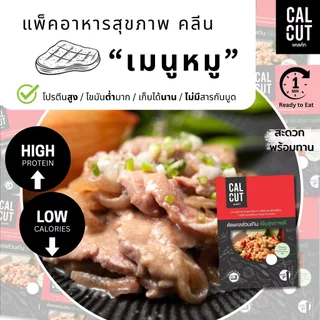
Calcut เมนูหมูสันใน หมู อร่อย อาหารสุขภาพ คลีน อาหารคลีน อาหาร อกไก่ เชฟเต้ย โปรตีน protein cleanfood 120g 500g (opens in a new tab)
See the current price and offers on Shopee
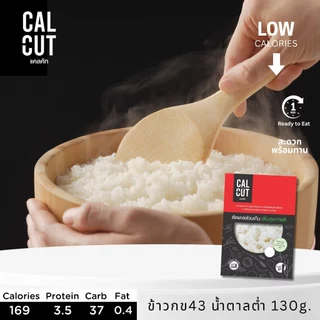
Calcut ข้าวสวย กข43 เส้นสปาเก็ตตี้ คลีน อาหารคลีน เชฟเต้ย ข้าวหุงสุก cleanfood ข้าว น้ำตาลต่ำ กข 43 อร่อย อาหารสุขภาพ (opens in a new tab)
See the current price and offers on Shopee
Product names are shown in Thai, as the sellers list them on Shopee Thailand.
Frequently asked questions
How many grams of protein should I eat a day?
It depends on your weight, exercise and goal. Healthy adults who exercise little need at least about 0.8 g per kilogram of body weight, for example about 44 g a day at 55 kg. People who exercise regularly or are losing weight usually need more.
Is too much protein dangerous?
For healthy adults, the ranges shown are appropriate. People with kidney disease, or at risk of it, need to be careful and should talk to a doctor. Eating far more than you need doesn't build extra muscle.
Do I need whey protein?
No. Food such as eggs, fish, meat, tofu, beans and milk can cover these ranges. Supplements are just a convenient option.
Do older adults need more protein?
The PROT-AGE expert group recommends at least 1.0–1.2 g/kg per day for adults aged 65 and over, more than the general adult range. Older adults with medical conditions, especially kidney disease, should talk to a doctor.
Further reading
- Weight & bodyIn Thai
What BMR is and how it's calculated (In Thai)
What BMR means, the formulas for men and women, and the activity multipliers.
- Weight & bodyIn Thai
Planning weight loss or gain with calories (In Thai)
How a weight plan works, and how daily calories and the timeline are calculated.